
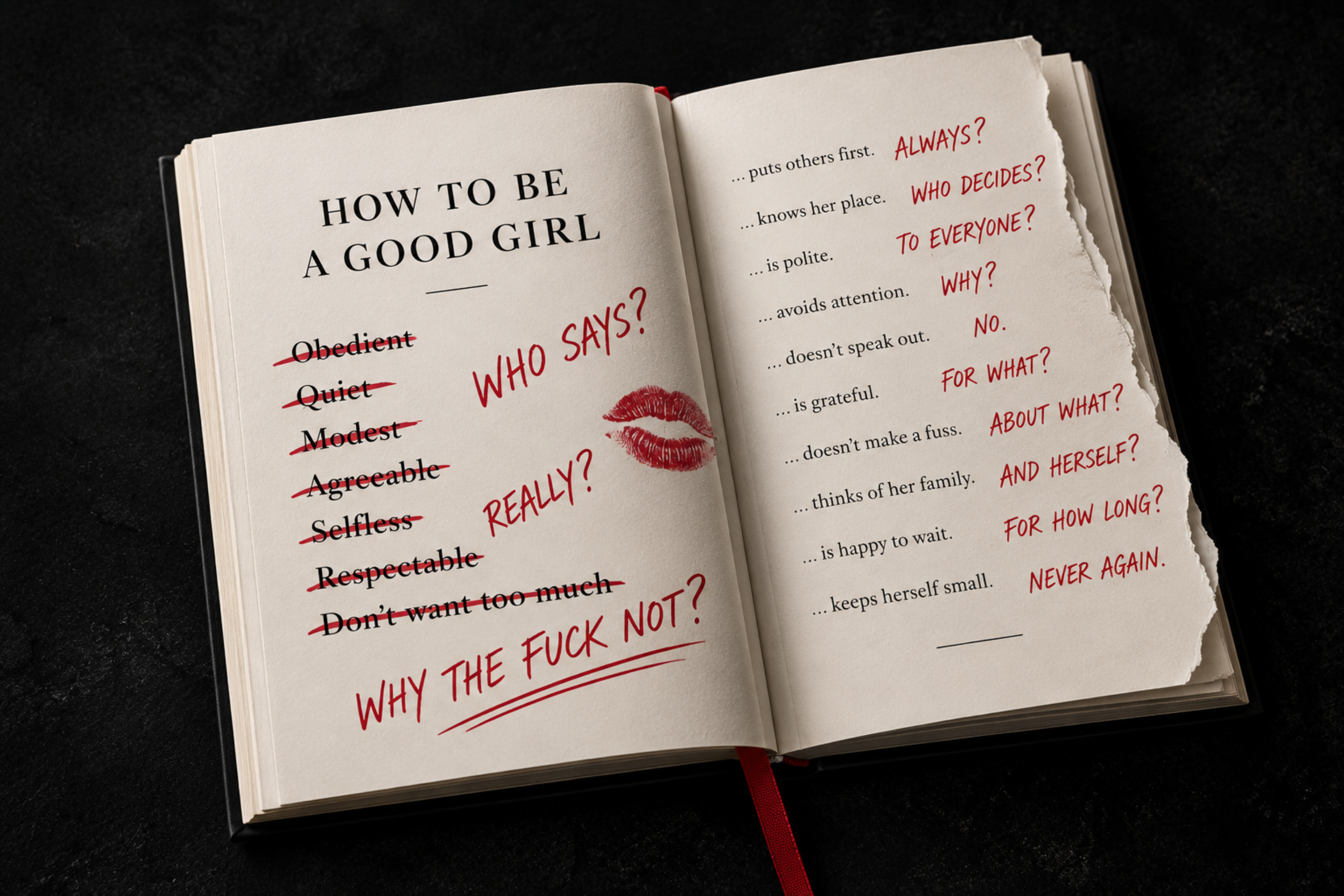
Nice guys finish last. So do good girls.
“Behind every woman who wonders if she comes across as too much is a good girl who learnt the price of being good. And how quickly the label changes when she wants more.”
Azalea Tailor
I was never a good girl. Not in the conventional sense anyway. My fate was sealed at birth and then reaffirmed around four years old, right about the time I developed a habit of silently letting myself out of the back gate and going wherever curiosity took me. Sometimes that was no further than the kitchen, where I’d open every cupboard and surround myself with the most colourful spices. Other times I was more ambitious.
Like the day I decided to catch a bus. I was four. My cousin was six. Between us, we had absolutely no business using public transport without an adult, but I had bus fare and confidence, which at the time seemed like perfectly adequate credentials. I managed to convince the driver that yes, of course my mum knew where we were going. He believed me too, right up until she came charging across the road just as the doors were about to close, screaming, “Are you an idiot, letting two children on a bus alone?”
I stood there looking suitably innocent while the poor man received the bollocking of his life, quietly slipping my change back into my pocket.
The funny thing is, I wasn’t particularly naughty, well not by my standards. I was curious. I saw somewhere I wanted to go and couldn’t understand why I shouldn’t go there. The fact I was four was just a little administrative detail.
And perhaps that’s where all this starts… Before girls learn what they should want.
Anyone who grew up in an Indian family will know, respect isn’t optional. You never disrespected your elders. If your grandmother gave you the look, you didn’t ask for a family meeting to discuss whether her communication style was supporting your emotional development. You immediately stopped doing whatever the hell you were doing at the time.
I never answered my parents back. Not because I was frightened of having an opinion, but because I knew the difference between having one and being disrespectful. I was lucky. My parents knew the difference too. They expected respect from me, but they never required submission.
The wider community had other ideas. In Indian culture biology is largely irrelevant when it comes to family. Every fucker is your aunt or uncle. People you’ve never met can appear at a wedding, establish that they once lived three streets away from your grandmother’s cousin in 1974 and immediately acquire the right to comment on your clothes, your behaviour, your weight, your marriage prospects and, given enough time, probably your bowel movements.
I remember walking home from college one day, with a boy. I was no more than seventeen. Walking. Fully clothed. In public. Hardly the stuff of family disgrace. An Indian woman who worked with my mum saw us and practically ran back to my mum to report the offence. Anyone would think she’d caught me working the streets rather than walking down one.
She found my mum and delivered the scandal “your daughter is walking with a boy.” My mum, bless her cotton socks, just looked completely flummoxed simply replied “And?” Wrong answer. The woman was in uproar. “I’m telling you, she’s walking with a boy, what will others say if they see her?”
All I can say is thank fuck she hadn’t followed us for another ten minutes, because there was a fairly decent chance she’d have caught me playing tonsil tennis with said boy. Come on, I was a seventeen year old girl, who had just discovered boys. But my mum, she didn’t ask who he was. She didn’t demand to know what I was doing with him. She didn’t tell me I’d embarrassed her or start worrying about what the community might say. She simply looked at this woman and said, “She’s allowed to walk with whoever she wants.”
And there it was. The strange contradiction of my childhood. I grew up surrounded by people who thought being an elder gave them editorial rights over the behaviour of every girl within a five-mile radius, while being raised by parents who fundamentally believed I belonged to myself. Yes, we had unspoken rules and boundaries. My parents made sure we understood them, but they never confused respect with submission. And perhaps that’s why, to this day, the very word makes my skin crawl. The community, though? They had a fucking handbook.
Good girls shouldn’t draw too much attention to themselves, behave too boldly or do anything that could embarrass the family. They certainly didn’t wander the streets with boys where somebody’s auntie’s neighbour’s cousin might see them. They were helpful, modest, considerate, sensible. And hovering over the whole thing was the unofficial Indian national anthem: What will people think?
Who were these people? Nobody ever fucking knew. They seemed to have no jobs, hobbies or domestic responsibilities because they had endless amounts of time to monitor everybody else’s daughters.
I was so lucky that home gave me room to be myself. I could be curious, independent and occasionally halfway to Coventry on public transport before anyone found me. But here’s the annoying thing about conditioning: you don’t have to swallow the whole rulebook for some of it to get inside you.
Submission? Well we’ve covered that. Keeping my opinions to myself? I think we can safely conclude that ship sailed before primary school. But being useful? Dependable? Looking after everybody? Keeping the peace? Knowing better because I was the eldest? Oh, I swallowed that shit whole.
Being the eldest daughter comes with a job description and contract nobody bothers to print and sign. I tied shoelaces, packed bags, remembered lunch money, mediated arguments, babysat, translated moods and generally behaved like an unpaid Operations Director. Nobody sat me down and said, “Your value lies in how much you do for other people.” They didn’t need to. I watched the women in my life do it beautifully. My grandmother could feed twenty people, solve three family problems, sew something useful out of a scrap of fabric and still somehow know somebody upstairs had forgotten their PE kit. She never asked for anything. She just quietly got on with it. My mum and aunt? They both stayed in marriages long after the love had left because that’s what women of their generation did. And me? I became the girl everybody could rely on.
So while I never learned to make myself smaller in the obvious ways, I did learn something many women know intimately: being good often means considering everybody else’s needs before your own. Then we grow up and everybody acts surprised that we struggle to ask for things. Like we’re supposed to stride into adulthood announcing what we want as though nobody spent the previous twenty years teaching us to consider how our wanting might inconvenience somebody else.
- Want more money? Careful. You don’t want to look greedy.
- Want that promotion? Don’t be pushy.
- Want recognition for something you did? Nobody likes a show-off.
- Want your partner to pull his bloody weight? Stop nagging him, he works hard. Me I’m just sitting here, twiddling my thumbs.
- Want to ask for what you like sexually? Stop being so bloody demanding.
- Enjoy sex too much? Well, now we’ve got an entirely different selection of vocabulary for you, none of which I’m sure your mother would like me to print.
- Don’t want children? Selfish. Want children and a career? Still selfish.
- Choose to leave a relationship because being vaguely content for the next forty years doesn’t sound particularly appealing? You’re so ungrateful.
- Say no to a family obligation because you’re exhausted? Selfish again. We do get a lot of mileage out of that one.
- Dare to ask for help? You’re so needy.
- Don’t ask for help and eventually collapse under the weight of doing absolutely everything yourself? You should’ve said something.
Oh, fuck off.
And here’s the good girl contradiction. We spend childhood rewarding her for being accommodating, modest, useful and undemanding, then release her into adulthood and tell her success requires visibility, negotiation, boundaries, self-belief and the ability to ask unapologetically for what she wants. No wonder so many women soften the sentence before it’s even left their mouths. Sorry, can I just… I might be completely wrong, but… I don’t want to sound difficult… It’s probably just me… Don’t worry if you can’t… Half the time we haven’t even made the request yet and we’re already apologising for the inconvenience of having one.
Don’t get it twisted, this isn’t confined to one culture. The packaging changes. Some girls get “What will people think?” Others get “That’s not very ladylike, or don’t be bossy, nobody likes a show-off.” Some get religion, some get respectability, some get class. And some get family honour while others get the peculiar British obsession with not appearing too pleased with yourself.
Underneath all the different packaging sits the same instruction: before you decide what you want, consider how everybody else might feel about you wanting it. That’s one hell of a thing to teach a girl. Because eventually she doesn’t need an aunt standing behind her telling her what’s appropriate. She can do the job perfectly well herself. She becomes her own aunt. And frankly, after years spent avoiding them, discovering I’d grown one inside my own head feels bloody unfair.
For years, I would’ve told you I escaped the good-girl conditioning. Look at my life. I built businesses. I made my own money. I left relationships. I chose not to have children. I’ve said no to plenty of things women of previous generations were expected to accept. I’ve made choices that would’ve given several imaginary aunties enough material to see them through an entire wedding season.
But I hadn’t escaped it. I’d just broken the obvious rules. The quieter ones came with me. The instinct to fix. To carry. To be dependable. To keep going. To say yes before I’d checked whether I wanted to. To feel responsible for how everybody else was feeling. To confuse being needed with being loved and being strong with needing less.
Turns out the little girl trying to get on the bus had more to teach me than I realised. She didn’t stand at the bus stop wondering whether wanting to go somewhere made her selfish, or worry that the driver might think she was too ambitious. She certainly didn’t ask whether the other passengers would approve of her destination. Admittedly, she was four and absolutely should not have been on the bus in the first place.
But still. Somewhere between being that little girl and becoming this woman, the world handed me a long list of things I should be. I ignored a fair few of them, absorbed others without noticing and spent much of adulthood working out which were mine in the first place.
Maybe that’s what becoming a woman really asks of us. Not whether we’re good girls or bad girls. Given the choice, I know which club I’d rather belong to. But whether the life we’re living was built from what we genuinely want, or from a lifetime of being told what women like us should want.
Good girls don’t always finish last. But sometimes they spend so long making sure everybody else gets where they’re going that they forget to ask where the hell they wanted to go in the first place. And I, of all people, should’ve remembered…
I’ve always known how to catch my own bus. Although these days, I prefer flights, preferably in first or business class. 💋